Code Review Has Become the Bottleneck in AI-Native Development
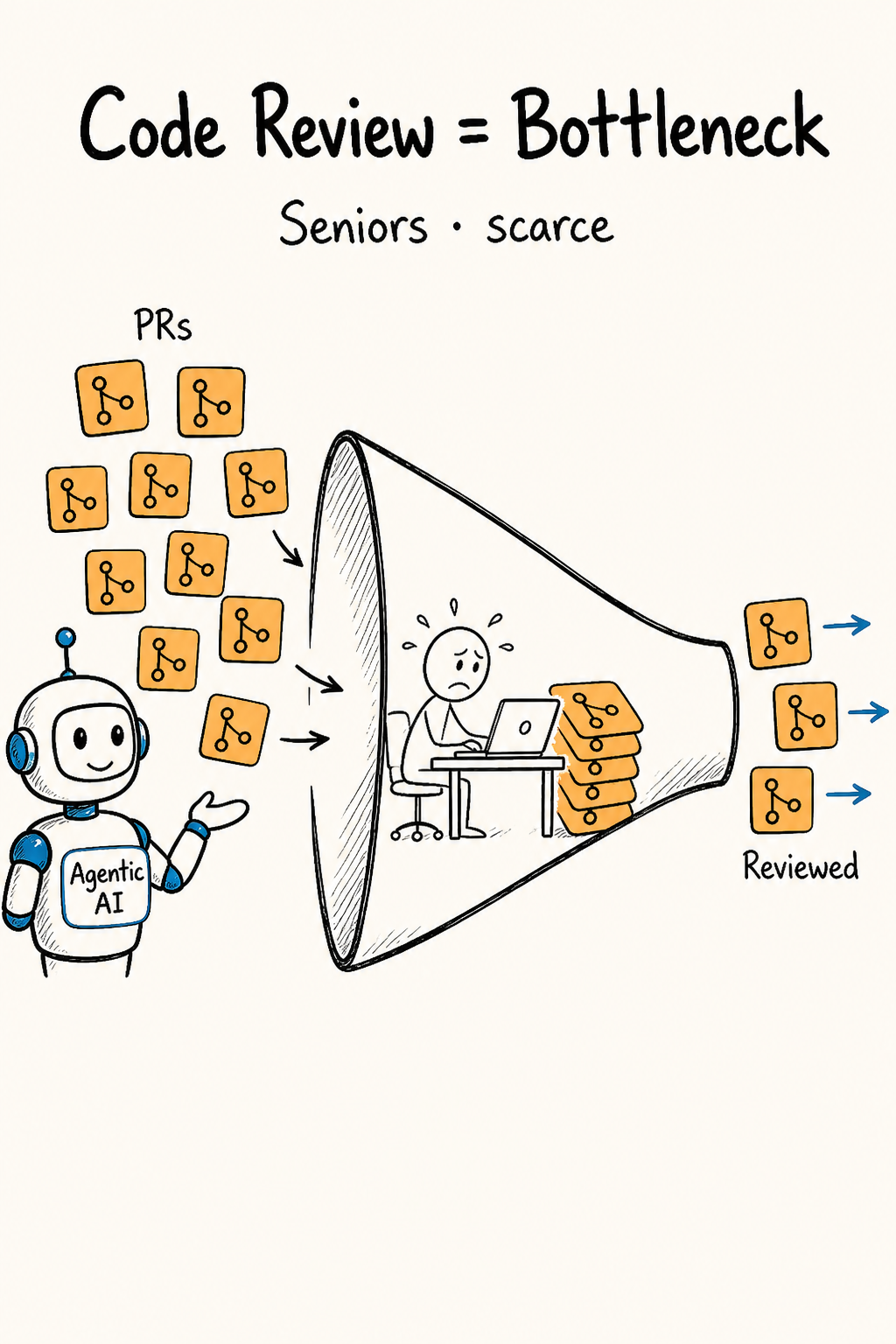
A practical challenge in adopting AI-Native development: code review has become the bottleneck.
Every organization has a handful of Senior/Lead Engineers and Architects who actually know the systems and the domain. Piling a growing queue of agent-generated PRs onto them is not a good use of their time. AI was supposed to free up their time, not consume it entirely.
Research shows median review duration is up 441%, PRs merged with zero review are up 31.3%, and incidents-to-PR ratio is up 242.7% (Faros AI).
Any of this sound familiar? You are not alone. Teams moving from AI-assisted to AI-Native workflows are hitting the same challenge. I wrote earlier about why most companies stall between AI-assisted and AI-led — this is one of the places that stall shows up in the day-to-day work.
We have solved this pattern before. QA used to be a separate team returning bug reports, and DevOps/Security used to be separate teams gatekeeping releases. Both got managed by shifting left, pushing the work earlier onto more capacity and context. Code review is doing the opposite. It is shifting right, onto the scarcest people in the org, just when AI is generating more code than ever. This one needs a different treatment.
Five ways to tackle this
1. Tier reviews. Senior engineers, or those with deep domain knowledge, take changes with the biggest blast radius. Low-risk changes with clear test coverage get a quick look, or get delegated. Match scrutiny to blast radius; different lanes for different risk.
2. Review packet. Every PR comes with a packet: the business reason, the approved spec, risk areas, test evidence, before/after screenshots. No packet, no review. Code review needs mandatory documents too — not just the flight journey.
3. Cap PR size. Agents produce large diffs by default; anything over the limit gets auto-rejected before a human sees it. A long weekend is great. A long 4,000-line PR is not.
4. Agentic pre-review. Let agents pre-review first, for completeness, size, and risk. You don’t blindly trust the output, but it tells you what needs real attention versus what can be cleared in five minutes. Human on the loop, not in every line.
5. Immutable tests and CI. Make CI and tests immutable. Agents are known to edit tests or loosen checks just to get their own task to pass. The crop is not allowed to eat the fence.
Theory of Constraints, applied
Find where work is actually stuck. Use pre-filters to gate, segment, and categorize the load. Spend domain-expert and senior engineer time on the biggest-impact changes. Elevate capacity where it helps. Measure and fine-tune this loop; then rinse and repeat — the bottleneck will move.
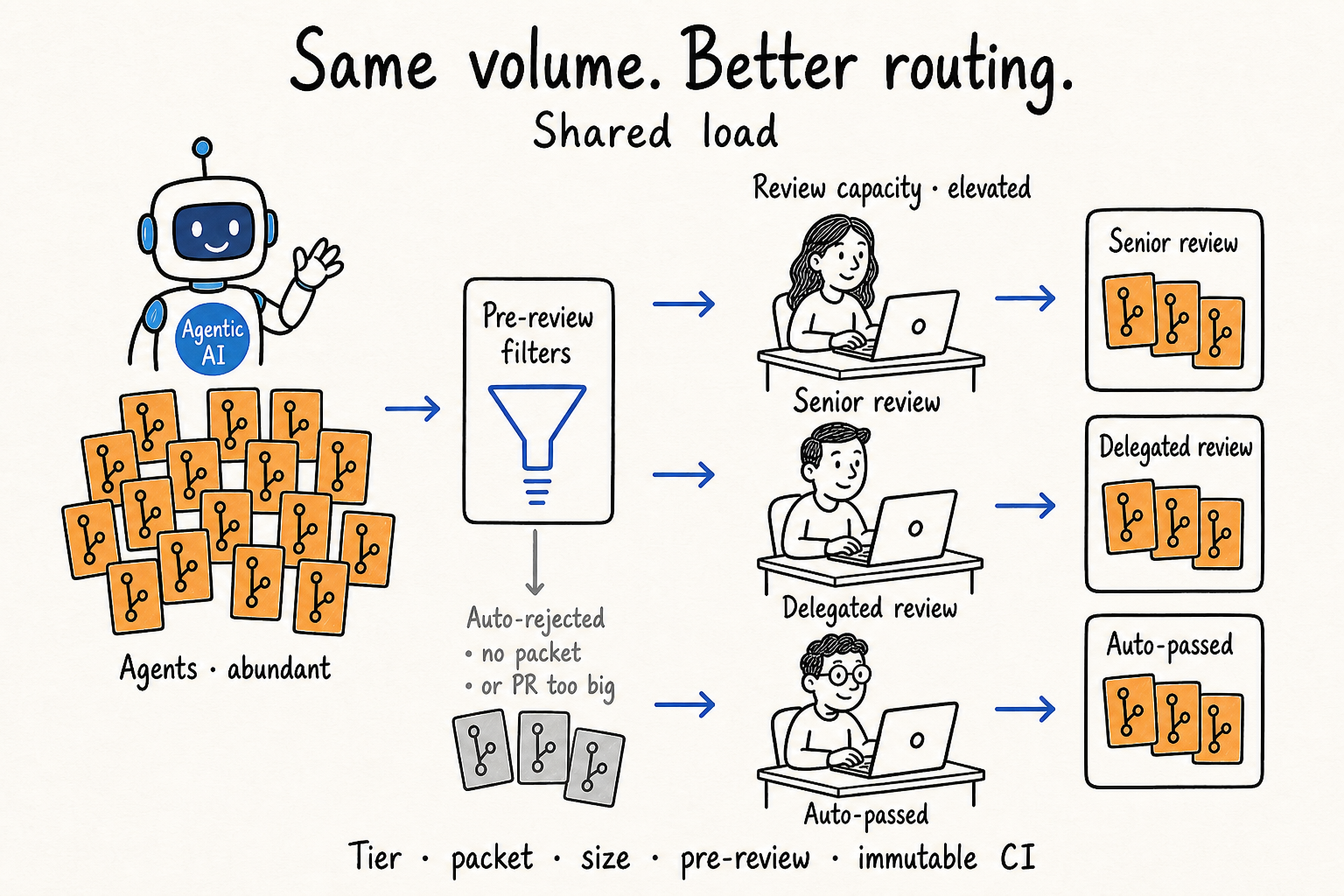
The companies that pull ahead and achieve disproportionate outcomes will be the ones with mature governance around what gets reviewed, how, and by whom — safely crossing the chasm from AI-assisted to AI-Native development instead of drowning in the queue.
Is your review process protecting your best engineers’ time, or quietly becoming the thing that burns it? What techniques have worked for you? I would love to hear from you — reach out.
#AISDLC #AgenticAI #AIDLC #CTO #SoftwareEngineering #CodeReviews
Resources:
- Faros AI, The AI Acceleration Whiplash — Ten Takeaways: https://www.faros.ai/blog/ai-acceleration-whiplash-takeaways
- Moderne.ai, AI Didn’t Break Coding. It Broke Code Review: https://moderne.ai/blog/ai-didnt-break-coding-it-broke-code-review
- Yuval Yeret, AI Coding Made Code Review the Bottleneck: https://yuvalyeret.com/blog/ai-coding-made-code-review-the-bottleneck/
- DevOps.com, AI Moved the Bottleneck from Writing Code to Understanding and Trusting It: https://devops.com/ai-moved-the-bottleneck-from-writing-code-to-understanding-and-trusting-it/
- CodeRabbit, Code Is No Longer the Bottleneck — Understanding Is: https://www.coderabbit.ai/blog/code-is-no-longer-the-bottleneck-understanding-is
- Addy Osmani, Agentic Code Review: https://addyosmani.com/blog/agentic-code-review/
- Related: From AI-Assisted to AI-Led: Why Most Companies Stall